By: Jeff Gong, Software Engineer, jeffgon@twitch.tvSahil Dhanju, Software Engineer InternChih-Chiang Lu, Senior Software Engineer, chihchil@twitch.tvYueshi Shen, Principal Research Engineer, yshen@twitch.tv
How to convert M4B to MP3? Try the Audio Transcoder! Key features of the best M4B-to-MP3 Converter: Lightning-fast conversion (multi-core optimized encoders to speed up conversions on modern PCs.) Batch mode for multiple files conversion task, Audio Transcoder can convert thousands of M4B files at once. In order for compliance with all broadcasting laws there is a legal requirement for the need to purchase an MP3 license key in-order to be able to encode your stream in MP3 (see section 3.10 for the related configuration entries). The license key should cost $5. Sunday, 11 July 2010 14:00 fre:ac is a free audio converter and CD ripper with support for various popular formats and encoders. It converts freely between MP3, M4A/AAC, FLAC, WMA, Opus, Ogg Vorbis, Speex, Monkey's Audio (APE), WavPack, WAV and other formats. Free audio transcoder 2.9.0.1316 key download software at UpdateStar - Audio Transcoder is an amazing music converter that allows you to convert audio files between many popular formats with the brilliant quality and ease.
Special thanks go toChristopher Kennedy, Staff Video Engineer at Crunchyroll/EllationJohn Nichols, Principal Software Engineer at Xilinx, jnichol@xilinx.com for their information on FFmpeg and reviewing this article.
Note: This is the first part of a 2-part series. Please read part 2 after finishing this article.
Background
Twitch is the world’s leading live streaming platform for video games, esports, and other emerging creative content. Every month, more than 2.2 million unique content creators stream or upload video on our website. At its peak, Twitch ingests tens of thousands of concurrent live video streams and delivers them to viewers across the world.
Figure 1 depicts the architecture of our live video Content Delivery Network (CDN) which delivers tens of thousands of concurrent live streams internationally.
Twitch, like many other live streaming services, receives live stream uploads in Real-Time Messaging Protocol (RTMP) from its broadcasters. RTMP is a protocol designed to stream video and audio on the Internet, and is mainly used for point to point communication. To then scale our live stream content to countless viewers, Twitch uses HTTP Live Streaming (HLS), an HTTP-based media streaming communications protocol that most video websites also use.
Within the live stream processing pipeline, the transcoder module is in charge of converting an incoming RTMP stream into the HLS format with multiple variants (e.g., 1080p, 720p, etc.). These variants have different bitrates so that viewers with different levels of download bandwidth are able to consume live video streams at the best possible quality for their connection.
Figure 2 depicts the input and output of the transcoder module in our live video CDN.
In this article, we will discuss
how FFmpeg satisfies most of the live transcoding requirements,
what features FFmpeg doesn’t provide, and
why Twitch builds its own in-house transcoder software stack.
Using FFmpeg Directly
FFmpeg (https://www.ffmpeg.org/) is a popular open-source software project, designed to record, process and stream video and audio. It is widely deployed by cloud encoding services for file transcoding and can also be used for live stream transmuxing and transcoding.
Suppose we are receiving the most widely used video compression standard of H.264 in RTMP at 6mbps and 1080p60 (resolution of 1920 by 1080 with a frame rate of 60 frames per second). We want to generate 4 HLS variants of:
1080p60 HLS/H.264,
720p60 HLS/H.264,
720p30 HLS/H.264
480p30 HLS/H.264
One solution is to run 4 independent instances of FFmpeg, each of them processing one variant. Here we set all of their Instantaneous Decoding Refresh (IDR) intervals to 2 seconds and turn off the scene change detection, thus allowing the output HLS segments of all variants are perfectly time aligned, which is required by the HLS standard.
FFmpeg 1-in-1-out Sample Commands:
_ffmpeg -i -c:v libx264 -x264opts keyint=
Notes:
From the above command, we are transcoding multiple variants out of a single input file. Each “” denotes a new line, in which we can specify a different combination of flags as well as a unique output name. Each command is independent of the other and can use any other combination of flags.
The primary differences for each command here can be seen in the s and r flags which are explained earlier in the article.
An alternative to running the following transcodes in a single FFmpeg instance is to run multiple instances, one for each desired output in parallel. The 1-in-N-out FFmpeg is a computationally cheaper process, whose reason we will explain next.
A Few Technical Issues
The previous section demonstrated how FFmpeg can be used to generate HLS for live streams. While useful, a few technical issues make FFmpeg a less-than-ideal solution.
Transmux and Transcode
In HLS, a variant is comprised of a series of segments, each starting with an IDR frame. The HLS spec requires that IDR frames of a variants’ corresponding segments be aligned, such that they will have the same Presentation Timestamp (PTS). Only in this way can an HLS Adaptive Bitrate (ABR) player seamlessly switch among the variants when the viewer’s network condition changes (see Figure 3).
If we transcode both the source and the rest of the variants, we will get perfectly time-aligned HLS segments since we force the FFmpeg to encode IDRs precisely every 2 seconds. However, we don’t have control over the IDR intervals in the source RTMP bitstream, which is completely determined by the broadcast software’s configuration. If we transmux the source, the segments of the transmuxed and transcoded variants are not guaranteed to align (see Figure 4). This misalignment can cause playback issues. For example, we have noticed that Chromecast constantly exhibits playback pauses when it receives HLS streams with misaligned segments.
For the source RTMP stream with variable IDR intervals, we ideally want the output HLS to look aligned like in Figure 5:
However, in both the 1-in-1-out and the 1-in-N__-out FFmpeg instances, the N encoders associated with the N output variants are independent. As explained above, the result IDRs will not be aligned (see Figure 4) unless all variants are transcoded (i.e. the highest variant is also transcoded not transmuxed from the source).

Software Performance
As discussed in Figure 2, our RTMP-HLS transcoder takes in an input of 1 stream and produces an output of __N__ streams (N = the number of HLS variants. E.g., N = 4 in Figure 5). The simplest way to achieve this output is to create N independent 1-in-1-out transcoders, with each generating 1 output stream. The FFmpeg solution described above utilizes this model and has N FFmpeg instances.
There are 3 components within a 1-in-1-out transcoder, namely decoder, scaler, and encoder (see Figure 6). Therefore, for __N__ FFmpeg instances, we will have N decoders, N scalers, and N encoders altogether.
Since the N decoders are identical, the transcoder should ideally eliminate the redundant N-1 decoders and feed decoded images from the only decoder to the N downstream scalers and encoders (see Figure 7).
We talked about the decoder redundancy above. Now, let’s take another look at the four-variant example.
1080p60 HLS/H.264,
720p60 HLS/H.264,
720p30 HLS/H.264, and
480p30 HLS/H.264
The two transcoded variants 720p60 and 720p30 in this example can share one scaler. As gathered from experiments, scaling is a very computationally expensive step in the transcoding pipeline. Avoiding the unnecessary repeated scaling process altogether can significantly optimize the performance of our transcoder. Figure 8 depicts a threading model of combining the scalers of 720p60 and 720p30 variants.
Open Source Audio Transcoder
Besides the decoder and scaler sharing, a more important feature is multithreading. Since both the encoder and scaler are very computationally expensive processes, it is critical to utilize the modern multi-core CPU architecture and let the multiple variants be processed simultaneously. From our experiment, we find multithreading very useful for achieving higher density and is critical for certain applications like 4K.

Custom Features
FFmpeg is a versatile video processing software supporting various video/audio formats for the standard ABR transcoding workflow. However, it cannot handle a number of technical requirements that are specific to Twitch’s operation. For example,
1) Frame rate downsampler
Our typical incoming bitstreams have 60fps (frames per second), and we transcode them to 30fps for lower bit-rate variants (e.g., 720p30, 480p30, etc.). On the other hand, since Twitch is a global platform, we often receive incoming streams of 50fps, most of which are from PAL countries. In this case, the lower bit-rate variant should be downsampled to 25fps, instead of 30fps.
Simply deleting every second frame is not a good solution here. Our downsampler needs to behave differently for the two different kinds of incoming bitstreams. One kind has constant frame rates less than 60fps, and the other has irregular frame dropping, which makes its average frame rates less than 60fps.
2) Metadata insertion
Certain information needs to be inserted into the HLS bitstreams to enhance the user experience on the player side. By building our own transcoder and player, Twitch can control the full end-to-end ingest-transcode-CDN-playback pipeline. This allows us to insert proprietary metadata structures into the transcoder output, which are eventually parsed by our player and utilized to produce effects unique to Twitch.
Files: 2
Info Hash: 7230657582b1e042ced8b6e8997d39fc56ce44e3
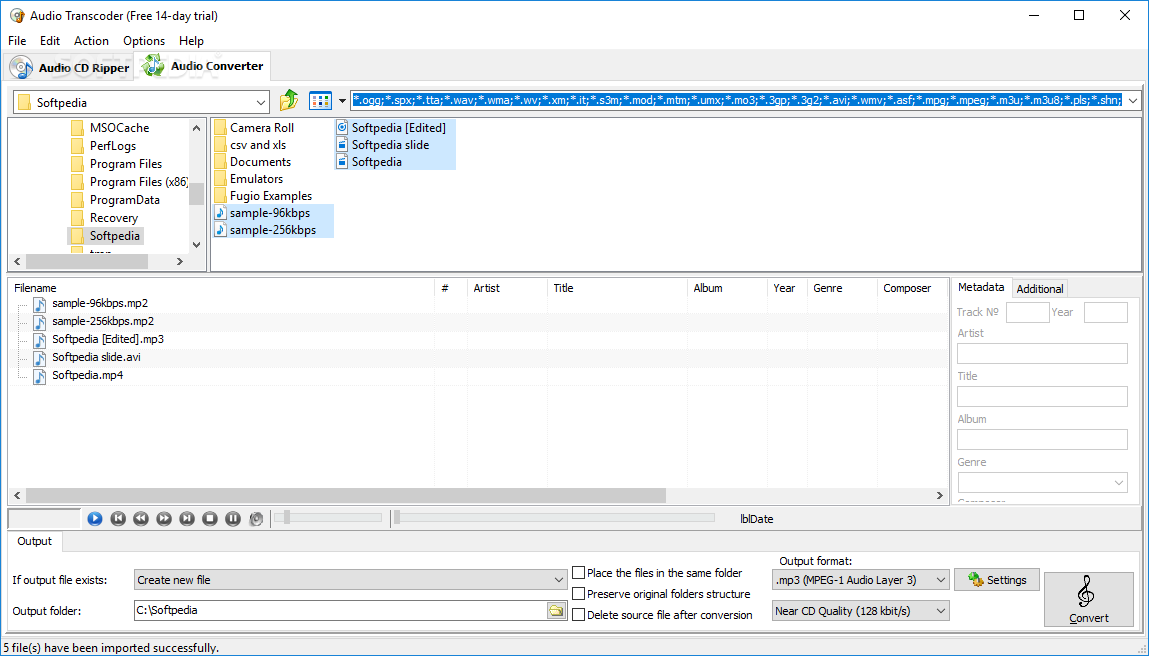
Audio Transcoder | Size: 14 MB Category: Multimedia|Audio|Audio Convertors Developer: Digital Music Software |
| Share ratio | Good: 23 Bad: 0 |
Free Transcoder
Free Video Transcoder
Audio Transcoder is an easy to use, technically elegant AUDIO L & amp; ecirc are converters for navigation use r all users that a BIG e has music collection. Audio Transcoder help YouConvert Audio L & amp; ecirc; Files between formats, rip audio tracks from a CD drive to one of the 14 supported navigation use to store tzten audio formats. As zus & Xenical tzlichen Bonus erm & ouml; glicht Audio Converter user to edit audio meta tags and in the output, load CD information from the Internet and play audio in the built-in CD player. Audio Transcoder is a children's audio L & amp; ecirc; Convert files in a new format. To get started, drag-and-drop a l & amp; ecirc ;? Are on the program's window, w Xenical you choose the output settings and click the Schaltfl arrow Xenical che Convert. Audio File Converter for navigation use leads the rest of the process on autopilot & amp; euml; Kidney. It converts audio quickly and in brilliant quality & Xenical t. In portable devices & Xenical th as iPhone, iPod, MP3 player, mobile phone and in WinAmp ge & ouml; OPENED files; When the conversion is completed, the user can music l & amp; ecirc load. Kopi & amp; euml, ring music tracks from a CD & Xenical resembles the sound success except that the user can search the CD for information in freedb database. If features navigation use gbar, the CD information is downloaded into the program. They include & ouml; ren data navigation use about the performance K & main navigation artist, album and song? Title. The specialties arrow Xenical t of Audio Transcoder l & amp; ecirc; supported in a variety of audio formats navigation use TZT. Currently, the program is more than 20 L & amp; ecirc; are types, including MP3, AAC, AC3, WMA, APE, AIFF, WAV, FLAC, M4A, MAC, MP +, MP1, MP2, MP3, MP4, MPC, MPP, total arrow Xenical USEFUL conditions, SPX Process, TTA, WAV , WV and Ogg Vorbis. The list of supported navigation use tzten formats is regularly arrow Xenical & szlig ig updated. Audio Transcoder is a must-h & amp; ecirc; Tool for navigation use r people on the go. There erm & ouml; glicht the user, Audio L & amp; ecirc; To convert files? Portable Help? Format and upload it to the iPhone, iPod, MP3 player, cell phone or PDA. Audio Transcoder k ouml, you can wirelessly your computer music and take it with you! |